Computer Vision Projects: From Planning to Production Deployment
A complete guide to implementing AI vision systems in manufacturing — phases, best practices, real ROI data.


What Are Computer Vision Projects?
Computer vision projects are systematic implementations of AI-powered visual inspection systems in manufacturing environments. They range from single-camera quality control systems on one production line to multi-site, multi-camera deployments across entire factories, integrated with ERP/MES systems.
A successful computer vision project isn’t just about buying software — it’s about planning the right use case, selecting technology, validating with a POC, training teams, and scaling sustainably.
Why Manufacturers Start Computer Vision Projects
- Months average ROI payback
- Rework cost reduction
- FTE labor displacement/line
Common Drivers for Computer Vision Projects
- Quality consistency — Manual inspection misses 10–20% of defects
- Labor shortage — Inspectors hard to find, expensive, high turnover
- Customer demands — Tier-1 customers require 100% traceability and automated QC
- Scaling pain — Can’t increase output without proportionally increasing inspection staff
- Regulatory compliance — GMP, FDA, ISO traceability requirements demand automated logging
- Scrap reduction — Every 1% scrap reduction on your line = €10,000–50,000/year saved
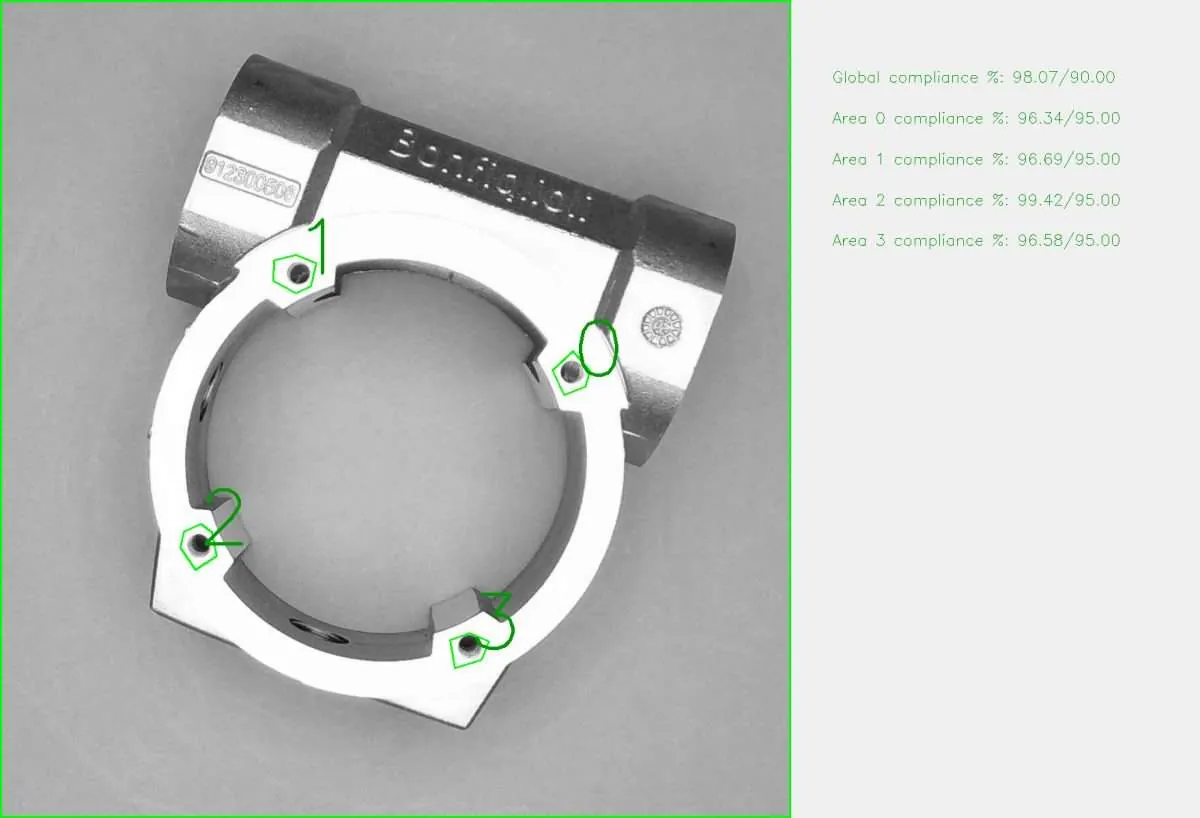
The 5 Phases of a Computer Vision Project
1
Discovery & Problem Definition
Timeline: 1–2 weeks
Define the problem: Which defects are missed? What’s the cost of a defect? How many parts per minute? What lighting/angles? What’s the customer impact?
- Audit current inspection process (manual or automated)
- Identify defect types and frequency
- Map production flow and line parameters
- Calculate baseline costs (scrap, rework, customer returns)
- Set success metrics (detection rate target, cycle time impact, cost savings)
2
Proof of Concept (POC)
Timeline: 2–5 days
Test computer vision on your actual parts in your actual environment. This is where you validate feasibility and get real numbers.
- Camera positioning and lighting setup
- Run 500–1,000 sample parts through the system
- Measure defect detection rate, false positives, cycle time
- Compare AI results vs human inspector on same parts
- Document findings and ROI calculation
- Decision: Proceed to production or refine scope?
3
System Design & Integration
Timeline: 1–2 weeks
Move from POC to production setup. This involves hardware sizing, connectivity, and integration with your production workflow.
- Select cameras, lenses, lighting, mounting hardware
- Design integrations: Conveyor sync? Reject mechanism? MES/ERP connection?
- Network architecture (local processing vs cloud)
- Data retention and backup strategy
- User interface design for operators and quality managers
4
Deployment & Training
Timeline: 1–3 days
Install the system on the production line with zero downtime. Train operators and quality staff on system usage and troubleshooting.
- Install hardware and calibrate
- Connect to production systems (conveyor, reject, ERP)
- Fine-tune AI model on live parts (usually 50–100 samples)
- Operator training: How to monitor, log results, troubleshoot
- Quality manager training: Dashboards, data interpretation, SPC
- Pilot run with production team
5
Optimization & Scaling
Timeline: Ongoing
After 2–4 weeks of production, collect data and optimize. Identify opportunities to scale to additional lines or products.
- Analyze defect data and trends
- Fine-tune detection thresholds based on real production
- Measure actual ROI vs projections
- Plan rollout to additional lines
- Continuous model improvement as production evolves

Technology Selection for Computer Vision Projects
In-Process (Real-time Inspection)
Camera mounted on or near the production line, inspecting parts as they move. Best for high-speed detection, immediate feedback to operators.
- Speed: 30–200 parts/minute
- Latency: 100–500ms
- Cost: €1,200–3,500/month (hardware + software)
Off-Line (Post-Production Inspection)
Inspection station after production. Best for complex analysis, multiple angles, or when speed isn’t critical.
- Speed: 5–60 parts/minute
- Latency: 1–5 seconds
- Cost: €800–2,000/month
Hybrid (Multi-Camera, Multi-Angle)
Multiple cameras inspecting from different angles simultaneously. Best for complex geometries or multi-parameter QC.
- Speed: 10–120 parts/minute per camera
- Cost: €2,800–5,500/month

Real Computer Vision Project Case Studies
Case Study 1: Electronics Manufacturer — PCB Defect Detection
Challenge: Contract manufacturer was inspecting 15,000 PCBs daily with 3 FTE inspectors. Defect detection rate was only 60%, leading to customer complaints and recalls.
Solution: Deployed computer vision PCB inspection system with 4 high-resolution cameras inspecting at 120 boards/min.
Results (30 days):
- Defect detection rate: 60% 98%
- Labor reduction: 3 inspectors 0.5 FTE
- Cost savings: €45,000/year in labor + €80,000 in reduced scrap
- ROI: 4.2 months
Case Study 2: Food Manufacturing — Grain Quality Control
Challenge: Grain sorting line processing 50 tons/day. Manual sorting missed 5–8% of foreign material, causing customer rejects.
Solution: Deployed AI-powered sorter with computer vision, inspecting 8,000 units/minute.
Results (60 days):
- Foreign material detection: 92%
- Waste reduction: 5.8% 0.8%
- Product recovery: €120,000/year in salvageable grain
- ROI: 2.1 months
Case Study 3: Pharma — Vial Inspection at Scale
Challenge: 2 pharma production lines needed 100% vial inspection (GMP requirement), but manual inspection was bottleneck limiting throughput to 200 vials/min.
Solution: Deployed 2-line computer vision system with rejection mechanism, enabling 600 vials/min throughput.
Results (90 days):
- Throughput increase: 200 600 vials/min
- Production capacity increase: 40% more output
- Defect detection: 3x more defects caught
- Additional revenue: €200,000/month from increased capacity
- ROI: 1.8 months
Computer Vision Project ROI Calculator
Quick estimate of payback time for a typical project:
| Metric | Typical Range | Your Estimate |
| Parts inspected/day | 1,000–50,000 | |
| Cost per defect found late (rework/return) | €5–50 | |
| Current defect miss rate | 5–20% | |
| Software cost/month | €1,200–3,500 | |
| Labor savings/month | €2,000–8,000 | |
| Expected ROI payback | 3–6 months | Your calc |
Ready to Start Your Computer Vision Project?
Every manufacturing project is unique. We conduct a free assessment of your line, identify opportunities, and run a POC with zero risk.
- parts or photos
- 20
- parts or photos
- days to results
- 5-7
- days to results
- no commitment
- €0
- no commitment
Common Challenges & Solutions
Challenge: “Our lighting changes too much — will AI work?”
Modern AI systems are trained to handle lighting variations. During POC, we test under multiple lighting conditions and train the model accordingly. Worst case: standardize your lighting (€500–2,000 investment).
Challenge: “We have multiple product variants. Do we need different models?”
Not necessarily. A single model can be trained to recognize multiple variants. However, if defect types differ significantly, separate models may be needed — this is identified in the POC.
Challenge: “Integration with our old ERP system sounds complicated.”
We provide REST APIs and can log data to any database, CSV export, or MQTT. Most integrations take a few hours. Worst case: log results manually to your system daily.
Challenge: “What if the system makes mistakes?”
False positives/negatives are configured during POC. We typically tune to 99%+ accuracy. Any questionable parts can be flagged for human review — humans + AI is more reliable than either alone.
Logirobotix | AI Computer Vision for Manufacturing
Via Pitoche 5B, 35012 Camposampiero (PD), Italy
www.logirobotix.com | info@logirobotix.com
© 2025 Logirobotix srl. All rights reserved. | Made in Italy
Trusted on production lines at



Related applications
-
 Solution
AI Quality Control That Never Sleeps
100% inline inspection at production speed. Defect detection accuracy 99.8%. Zero sampling bias. Real-time decisions every millisecond.
Read - Solution
Custom AI Vision Services
Bespoke computer vision systems engineered around your unique production challenges. From design to deployment — we build solutions that work for the problems…
Read - Solution
Detect Missing O-rings
100% accurate O-ring presence detection at production speed. Catch assembly errors before they ship.
Read